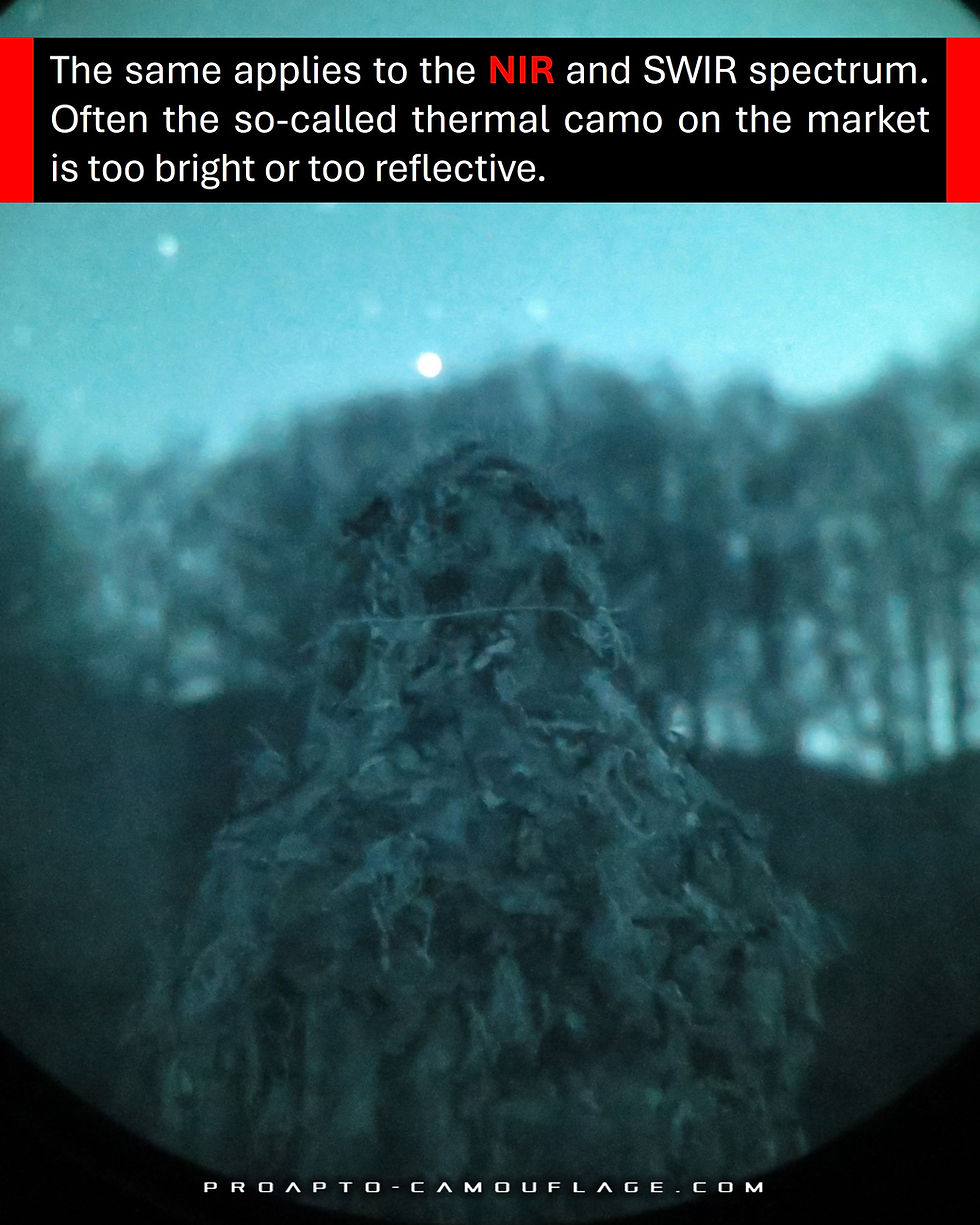
A concise article covering the reasons why multispectral sensors cost more than normal observation tools and why thermal camouflage costs follows the same fate...

Some units approached us with a dedicated budget for acquiring thermal camouflage. This budget was usually “tailored” around the typical pricing of rain ponchos, uniforms, and ghillie suits. However, multispectral technology applied to textiles significantly increases production costs. In some cases, the allocated budget was insufficient, causing acquisition delays of one or even two years becauuse of such cognitive bias.
The purpose of this concise article is to educate purchasing departments and end users about this technology, its real level of complexity, and its appropriate cost range. While 400–800 euros are usually enough for a military uniform or suit, and 2,000–3,000 euros are sufficient to acquire top-level ghillie suits, this budget will generally not cover the acquisition of proper multispectral camouflage * (see the last slide for what we mean by proper multispectral camouflage).
In the next paragraphs we cover why thermal camouflage and in general multispectral camouflage requires greater fuding allocation. Let’s proceed with multispectral sensors market to provide the ground.
Have you ever wondered why NVG, thermal cameras, and multispectral sensors are costly?

The main reason is the lack of economy of scale.The materials and manufacturing processes required to produce NVG, thermal cameras, and SWIR sensors are highly specialized and are not yet cost-effective at large scale. While NVG and thermal cameras are becoming more affordable due to increased production volumes and improved economies of scale, SWIR and other multispectral sensors remain significantly more expensive.
More broadly, adding remote sensing capabilities to an existing system results in a significant increase in price, changes maintenance requirements, and also certain trade-offs in performance. For example, some sensors can overheat easily because of their multispectral capabilities, some others can be affected by sunlight irradiation, rain or cold resulting not usable, and others may generate additional noise, or have limited battery life or simply being heavier tha normal observation devises.
Here in the gallery we show the average cost increase associated with adding remote sensing and/or multispectral capabilities to a given asset. Prices are typical ranges for professional military devices and refer to real tender acquisition within NATO.
The impact of adding multispectral capabilities
As shown above outlisnes how Implementing multispectral technology in a given asset, like for example develop a multispectral binocular or adding multispectral capabilties to an existing drone, sharply increases its price, often by 5 to 30 times its original costs.
The device category switches from observation devices tool (monocular, binocular, drone) to the niche category of Multispectral Technologies. The integration of multispectral capabilities moves the product into a completely different technological category: the category of multispectral systems. For example, a regular monocular equipped with VIS and TIR (visible and thermal infrared) capabilities is no longer simply a monocular. It becomes part of the multispectral technology sector, with different applications, operational requirements, manufacturing processes, pricing and more importantly: lack of economies of scale (this is more marked for multispectral and SWIR sensors and less for thermal cameras and analog NVGs).
While these changes in price, weight, and performance trade-offs are generally accepted by both professionals and the general public when dealing with remote sensing equipment, when it comes to multispectral camouflage, in some people there is a significant cogntive biases about thermal camouflage performances and costs. Some wrongly categorise thermal camouflage within the same product category (and so price range) as conventional military clothing, whereas in reality multispectral camouflage textiles and designs belong first to a different technological class, and, as such, they require significant technical effort and costs to achieve multispectral performances. This is particularly relevant for passive technologies that do not require batteries and cicruitry. In the next paragraph we cover why thermal camouflage is first a multispectral technoloy, and in a second instance in the category of clothing.

Why does thermal and multispectral camouflage belong to the same technological category as remote sensing systems?
Four main factors place thermal camouflage within the same technological domain as thermal sensors and multispectral systems:
1. The same technological field: remote sensing and countermeasures
Multispectral camouflage operate in the same technological ecosystem as remote sensing and countermeasure technologies. Semantically they belong to the same niche of remote sensing, and they require the same branch of academic studies (physic, nanotechnologies, chemistry, engineering), which mandates high level of academic and scientific expertise to operate in this field.
2. Limited economy of scale
Both products are mostly for military use and the general public have limited access to it. While for multispectral sensors the defense market is 44%, with multispectral camouflage defense market is 100% (read here). Therefore the limitation of lack of industrial produciton are even more pronounced for multispectral camouflage. Unlike conventional textiles, these products rely on customised materials, specific treatments, and specialised manufacturing methods that currently can be performed only in limited production volumes since large acquisition tenders are not in place yet and the civlian market is off topic. This naturally results in higher costs.
3. Similar nano-techonologies
Both multispectral sensors and advanced camouflage solutions rely on specialized materials often treated with nano-coatings of minerals, metals, and rare-earth. These manufacturing processes require the same advanced machineries. This is not true for every thermal camouflage product available on the market, but it applies to genuine multispectral camouflage solutions.
4. Synergistic market trajectory
The demand and growth of multispectral camouflage and multispectral sensing technologies are interconnected. As detection technologies evolve, the need for advanced countermeasure technologies grows simultaneously. Since the multispectral sensor market is growing the multispectral camouflage market is also surging to keep the pace (read here).

What is the cost of implementing Multispectral camouflage capabilities to textiles?

Multispectral camouflage fabric is not simply textile. The final price change of functionalising textiles to achieve multispectral camouflage is similar but not large as multispectral sensors.
Indeed, designed multispectral camouflage (particularly for the MWIR, LWIR and SWIR) requires customised technological processes, often coming from inventions (patents), specific nano-coatings on specifically engineered textile substrates and dedicated manufacturing processes, uncommon in the textile industry. Because of this, the lack of the economy of scale heavily affects prices.
So, how to reduce costs?
The answer is the economies of scale. Larger orders in military tenders significantly reduce overall costs.
Similarly, but with greater impact on cost reduction, opening to the civilian market would result in increased accessibility to multispectral camouflage technology also for the military, just as it did for thermal cameras, analog NVGs, and drones, which in the last decade became publicly highly accessible.

Conclusion
A common misunderstanding is that multispectral camouflage clothing is expensive because it is “just a textile product.” This is incorrect.
Multispectral camouflage and thermal camouflage garments are not merely textile garments. They are multispectral technologies applied to textile platforms. The cost comes from the technology embedded within the fabric: the materials, manufacturing techniques, specialized treatments, and in some cases specific patents that define the designs and technological processes required to achieve multispectral performance without relying on batteries, electronics, or circuitry. If it were simply a textile product, it would not have these technological limitations, costs, and manufacturing challenges. The correct comparison is therefore not with rain ponchos, uniforms, or traditional camouflage garments. The correct comparison is with other multispectral technologies.

Discover more about our multispectral technologies in this blog article and this video below: